Fathah, Kasrah and Dammah: How to Read the Three Short Vowels
By Rahman School
Fathah, kasrah and dammah are the three short vowels of Arabic. They are not letters. They are small marks written above or below a letter, and each one tells you which short sound to add. Fathah, a small stroke above the letter, gives an “a” sound. Kasrah, a small stroke below the letter, gives an “i” sound. Dammah, a small loop above the letter shaped like a tiny و, gives a “u” sound. Each one is held for exactly one beat.
This guide follows the order of the Rahman Quranic Reading Method, a new book by Rahman School that is not yet used in Rahman School’s current classes. It covers Units 3 to 6 of the book, where the three short vowels are taught one at a time and then read together until reading becomes automatic.
At a glance
Vowel
Mark
Where and what shape
Sound, on ب
Fathah
◌َ
above, a short stroke
“a”: بَ ba
Kasrah
◌ِ
below, a short stroke
“i”: بِ bi
Dammah
◌ُ
above, a small loop
“u”: بُ bu
All three are held for the same length: one beat.
You may also see these marks spelt fatha, kasra and damma, and called harakat as a group, as in Rahman School’s Quran and Arabic glossary.
By the time a learner meets the vowels, they already know the letters by name, shape and sound. But a letter on its own is hard to say. You know that ب is called ba and makes a “b” sound, yet “b” by itself is not something you can really pronounce: try it, and you will find yourself adding a vowel without meaning to.
Arabic solves this with three small marks. They are not letters; they are signs written above or below a letter to tell you which sound to add. There are three of them, and only three.
Each short vowel is worth exactly one beat, about the length of a single clap. Not longer. Later in the book the learner meets sounds that last two beats, the long vowels, and getting one beat right now is what makes two beats easy to hear later.
The book teaches the three marks one at a time. Fathah comes first because it needs the least control: the mouth simply opens. Kasrah and dammah each ask the learner to move the jaw or the lips more deliberately, so they come after.
Fathah: the “a” sound
Fathah is a short stroke leaning above the letter: ◌َ. It gives the letter the sound “a”, as in the English word cat. So ب with a fathah, بَ, is read “ba”: the letter gives the “b” and the fathah gives the “a”. Together they make one syllable, held for one beat.
How the book describes the sound. Open your mouth as if you were going to say “ah”, but only a little, about the width of one finger. The tongue lies flat and low, and the lips are relaxed, neither spread nor rounded. Say it short. If it sounds like “aah”, it is too long.
Here is fathah on three letters. Arabic is read from right to left, so start with the syllable on the right: بَ تَ مَ
Blending: sliding, not stepping
When two letters with vowels stand together, they are not read as two separate sounds with a gap between them. They slide into each other and come out as one smooth sound. Most beginners step: “ba”, pause, “ta”. What is wanted is the slide: “bata”, in one movement.
The book gives three steps:
Look right. Find the letter on the right. That is where you begin.
Say it with its mark. Letter plus vowel, one beat.
Run into the next one. Do not stop and do not take a breath; let the first sound run straight into the second.
For example, بَ and تَ together are read بَتَ, as one sound.
Three letters work in exactly the same way; the only difference is that you keep sliding for longer.
Here is a group built up one step at a time: كَ, then كَتَ, then كَتَبَ. That last group is a real Arabic word, kataba, which means “he wrote”. If a learner stops before the third letter, the book’s advice is to start the group again from the beginning, not from the middle.
Heavy letters with fathah
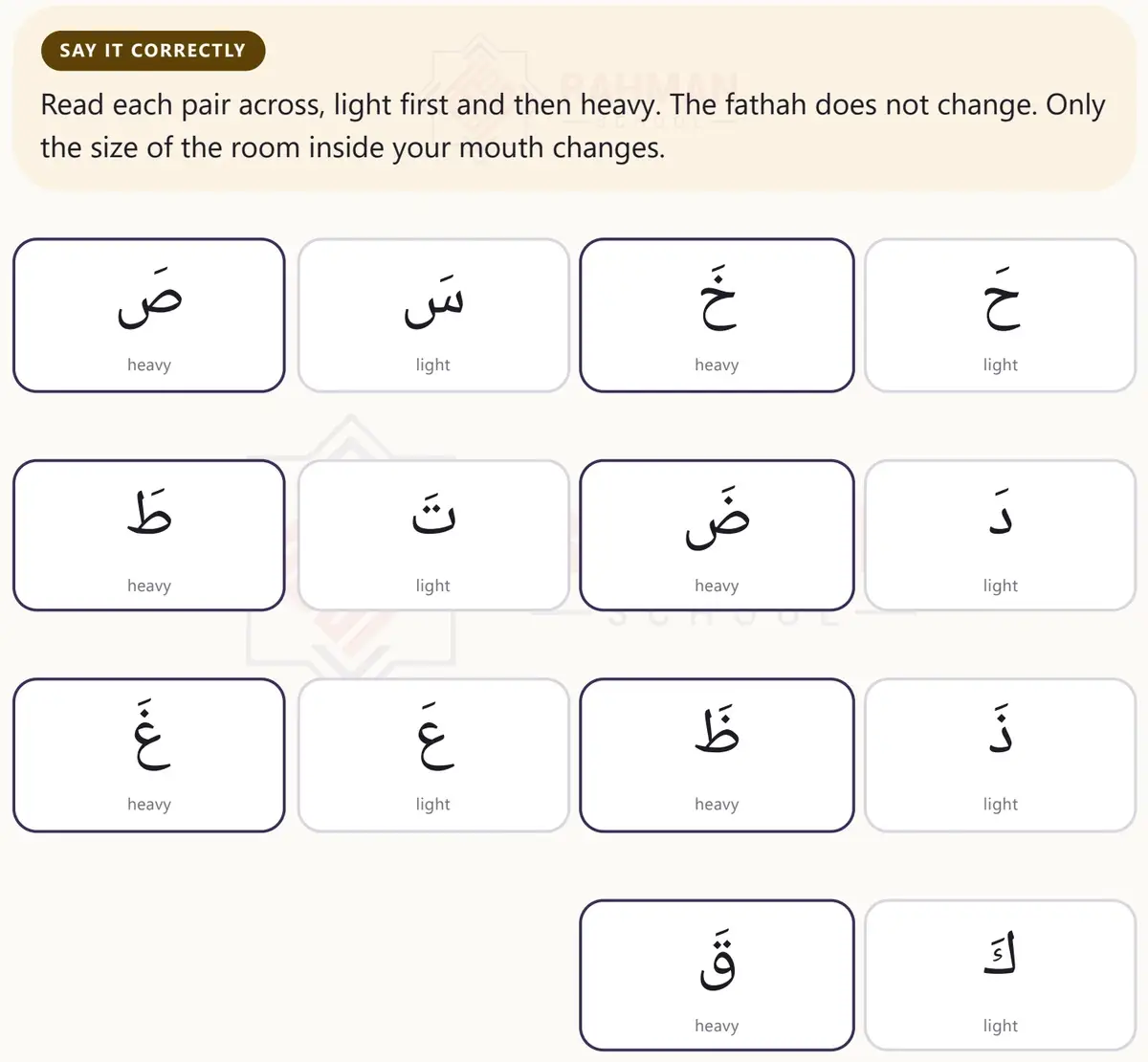
Some Arabic letters are heavy, said with a fuller mouth. The vowel does not change on a heavy letter; the letter is what makes the sound heavy. The book practises each heavy letter beside its nearest light partner, light first and then heavy, so the learner can hear the difference while the fathah stays the same:
Light
Heavy
سَ
صَ
تَ
طَ
كَ
قَ
Heavy and light letters side by side, from page 61 of the Rahman Quranic Reading Method. Tap or click the image to see it full size.
If a learner cannot hear the difference, the book’s teacher note suggests saying the pair with a hand resting flat on top of the head: the heavy letter is felt lower and further back.
Kasrah: the “i” sound
Kasrah is a short stroke written below the letter: ◌ِ. It is the only one of the three marks that sits underneath. It gives the sound “i”, as in the English word sit. So ب with a kasrah, بِ, is read “bi”: the same letter, the same one beat, but a different mark and so a different sound.
How the book describes the sound. Raise the middle of your tongue towards the roof of your mouth, and drop your jaw only slightly. The lips spread a little, as if beginning a small smile; they are never rounded. Keep it to one beat. If it sounds like “ee”, it is being held too long.
The most common error is an English long “ee”. Compare the short “i” in sit with the long “ee” in see, and keep kasrah short.
Here is kasrah on the same three letters, again read from right to left: بِ تِ مِ
Above or below?
Fathah and kasrah are almost the same shape: a short stroke. What separates them is where the stroke is. So when you meet a mark, ask one question: is it above the letter, or below it? Above means “a”; below means “i”.
Above: “a”
Below: “i”
بَ دَ سَ
بِ دِ سِ
Heavy letters with kasrah
This is the hardest combination in the unit. Kasrah pulls the mouth into a thin, spread shape, while a heavy letter needs a full one, so a heavy letter carrying a kasrah asks the mouth to do two opposite things at once. The book’s answer is that the letter wins: the mouth stays full, and the vowel is made inside that fuller space.
Light
Heavy
سِ
صِ
تِ
طِ
كِ
قِ
Dammah: the “u” sound
Dammah is a small loop written above the letter: ◌ُ. It sits in the same place as fathah, but it is a loop rather than a stroke, shaped like a tiny و. It gives the sound “u”, as in the English word put. So ب with a dammah, بُ, is read “bu”, for one beat, exactly like the other two.
How the book describes the sound. Round your lips, as if you were about to blow out a candle, and push them forward a little. The back of the tongue rises slightly and the jaw stays fairly closed. One beat only. If it sounds like “oo”, the lips are being held too long.
Here is dammah on the same three letters, read from right to left: بُ تُ مُ
Dammah is taught last because it needs the most deliberate lip movement. A learner who leaves the lips relaxed produces something close to fathah, and the two then blur together. Fathah and dammah are also the pair most often confused on the page, because both sit above the letter. The difference is the shape, a stroke or a loop, and the lips.
Telling the three apart: two questions
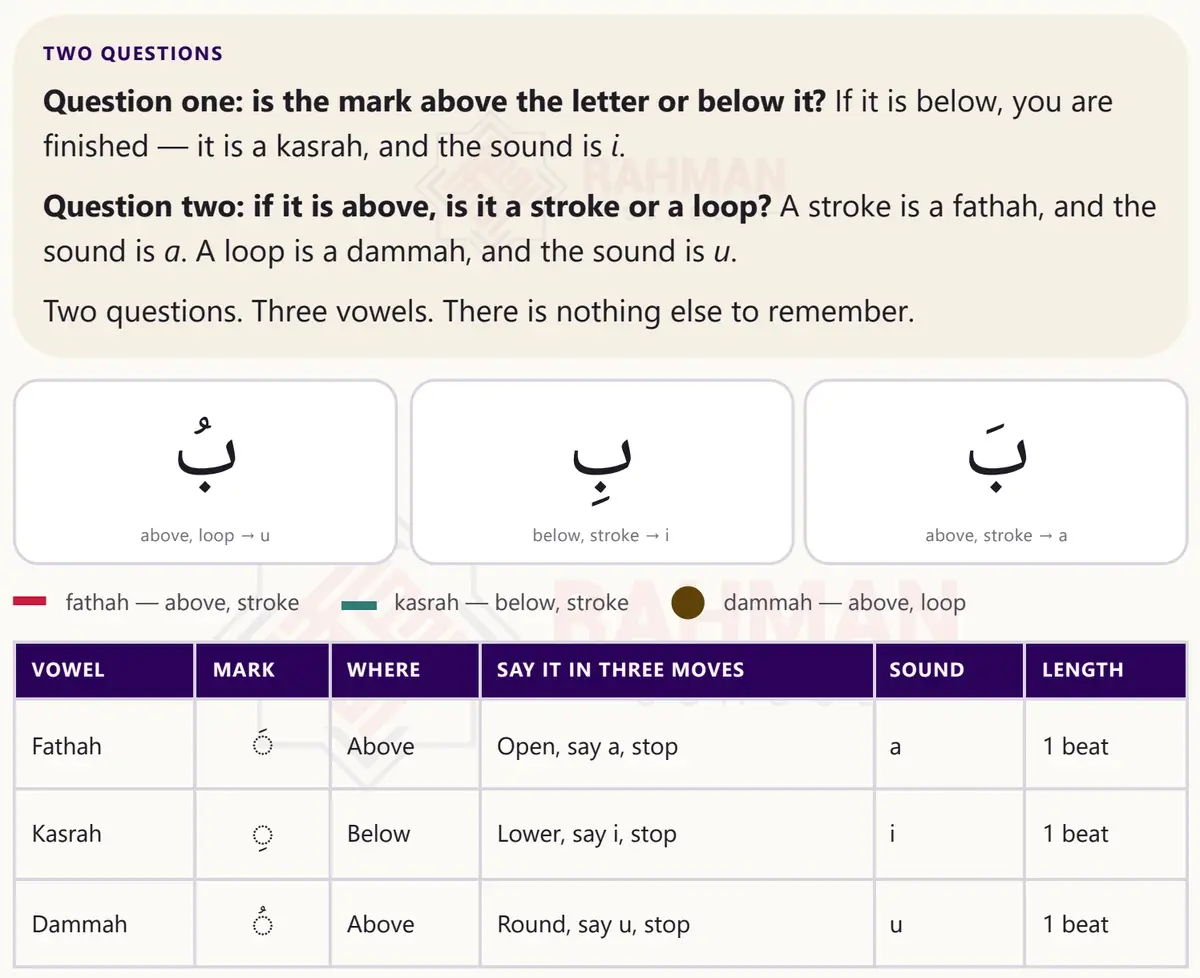
Once all three vowels are known, the book teaches a short routine for identifying any of them. It uses two questions and nothing else:
Is the mark above the letter or below it? If it is below, you are finished: it is a kasrah, and the sound is “i”.
If it is above, is it a stroke or a loop? A stroke is a fathah, and the sound is “a”. A loop is a dammah, and the sound is “u”.
The two-question routine, from page 83 of the Rahman Quranic Reading Method. Tap or click the image to see it full size.
The book sums the routine up in a small table. Each vowel is said “in three moves”, and each lasts one beat:
Vowel
Mark
Where
Say it in three moves
Fathah
◌َ
above
open, say “a”, stop
Kasrah
◌ِ
below
lower, say “i”, stop
Dammah
◌ُ
above
round, say “u”, stop
Now read these rows. Each row is one letter with the three vowels in order. Start on the right: “a”, then “i”, then “u”.
كَ كِ كُ
لَ لِ لُ
نَ نِ نُ
The book recommends teaching the two questions as something the learner says aloud. A learner who can say the routine will fall back on it under pressure; one who has only looked at the three marks side by side is more likely to guess.
Short practice exercises
These four short exercises use items from the book’s practice pages. Read each one aloud, ideally to a teacher, and check the answers at the end.
Exercise 1: above or below? Each pair is the same letter twice. Start with the syllable on the right, then read the one on the left. Only the mark moves.
بَ بِ
طَ طِ
جَ جِ
Then read them again with the left-hand syllables covered, so you see only one syllable at a time. The book’s teacher note calls this second run “the real test”.
Exercise 2: name the vowel. For each syllable, say which vowel it carries, then read it aloud.
No.
Syllable
1
حِ
2
زَ
3
غُ
4
ثُ
5
نَ
6
فُ
7
ظِ
Exercise 3: blend without a pause. Read each pair of letters as one smooth sound, with no gap in the middle.
خَفَ
نَمَ
تَبَ
مَوَ
Exercise 4: real words. Each of these is a real Arabic word that uses only letters and the three short vowels. Name the vowel on each letter, then read the whole word as one sound.
Word
Meaning
عَلِمَ
he knew
كَرُمَ
he was generous
حَسُنَ
he was good
فَرِحَ
he was glad
Answers
Exercise 1: in each pair, the right-hand syllable has a fathah (“a”, mark above) and the left-hand syllable a kasrah (“i”, mark below).
After the three vowels, the book spends a whole unit, Unit 6, on teaching nothing new. Its purpose is to move the learner from working the vowels out to simply reading them.
The book explains why with a picture: your attention is like a small bucket. While every mark has to be worked out, the bucket is full, and there is no room left for anything else. That is why a learner can read every syllable on a page correctly and still have no idea what the page said.
When reading the marks becomes automatic, the bucket empties, and there is room for meaning and, later, for the rules of recitation.
Automatic does not mean fast and careless. It means the answer arrives without being worked out, in the same way that you read this sentence in English without spelling out each word.
The book’s reading sprints follow the same pattern each time:
Run 1, accuracy. Read every item correctly. Do not hurry.
Run 2, speed. Read the same items as fast as you can without a mistake, and note the time.
Run 3, two days later. Come back to the same page and time it again.
Accuracy is never traded for pace. The book also suggests tapping a steady beat on the table: an even pace is a better sign of real fluency than raw speed.
The gate at the end of Unit 6 is a mixed page read at a steady pace, without stopping to work out any mark, and with no rise in mistakes as the pace increases. Only then does the book move on to long vowels, because a long vowel is taught as a contrast with the one-beat short vowel.
Spotting the short vowels in the Quran
Units 3 to 6 use ordinary Arabic words for practice, not Quranic quotations. Later in the book, in Unit 16, the learner reads complete short surahs. Some of the words in them are written with letters and the three short vowels only, so a learner who knows fathah, kasrah and dammah can already find them.
Listen to the complete verse: Surah An-Nas, Quran 114:2
In this verse (Quran 114:2), look at the first word, مَلِكِ. Its three letters carry a fathah, then a kasrah, then another kasrah.
A note on the last word of each verse. When a reader stops at the end of a verse, the usual way is to stop with a sukoon: the last letter is still pronounced, but without its short vowel, and the -n sound of tanween is dropped. So Quran 112:1 ends ahad, not ahadun, and Quran 114:2 ends an-nas, not an-nasi. Each of these two stops brings one more rule. The final letter of ahad is dal, one of the five qalqalah letters, so when the reader stops on it, it is released with a slight bounce. The five letters that bounce in this way are explained in Qalqalah and Sukoon: The Five Bouncing Letters Explained. In an-nas, the long vowel now comes straight before a letter with no vowel, so it may be held for two, four or six counts (madd arid lis-sukun). The marks stay on the page, and they are pronounced whenever the reading carries on without a stop. The two words this article points to, huwa and maliki, sit in the middle of their verses, so every short vowel in them is heard. (Tajweed also teaches two lighter ways of stopping: rawm, a faint trace of the vowel, which may be used on both words, and ishmam, a silent rounding of the lips, which is used only after a dammah, so only on ahad. Both are learned with a teacher.)
The other words in these verses also carry marks such as sukoon and shaddah, which the book teaches in later units. For now, look only for the three short vowels, and listen to the verses recited by a qualified teacher.
Common mistakes
These are the mistakes the book’s teacher notes warn about most often:
Letting heavy letters go thin. The vowel stays the same, but the heavy letter must still sound full, especially with kasrah.
Stretching the vowel. “Aah”, “ee” or “oo” means the vowel has been held too long. Every short vowel is one beat.
Pausing in the middle of a pair. The book calls this the single most common fault at this stage, and one that is very hard to remove once it becomes a habit. Correct it early.
Stopping before the third letter. If a three-letter group breaks, start it again from the beginning, not from the middle.
Mixing up fathah and dammah. Both sit above the letter. Check the shape, a stroke or a loop, and round the lips for dammah.
Guessing from position or pattern. Learners who read too fast stop looking at where the mark is. Reading letters out of alphabetical order, with the vowels mixed and no pattern, is what makes the learner look at every mark.
Helping a learner at home
A parent who does not speak Arabic can still support regular practice at home. However, the correct pronunciation of each vowel must come from a qualified teacher or an approved pronunciation model. Within that, the book’s own routines are easy to use:
Ask the learner to say the two questions aloud before reading a mark: above or below, stroke or loop.
Tap a steady beat and ask for an even pace rather than a fast one.
After a page has been read, cover half of it and ask for the other half on its own.
Keep accuracy first. Time a page only once it can be read without mistakes.
The book moves on to long vowels only when the short vowels are read without being worked out. A learner who needs more time on this stage is not failing; they are building the base that everything after it rests on.
Frequently asked questions
Are fathah, kasrah and dammah letters?
No. They are small marks written above or below a letter. The letter gives the consonant sound, and the mark tells you which short vowel to add.
How long is a short vowel held?
One beat, about the length of a single clap. Fathah, kasrah and dammah are all held for the same length.
What is the difference between a fathah and a double fathah?
A double vowel mark at the end of a word is called tanween. It adds an “n” sound that is not written as a letter. The book teaches it after the long vowels, in Unit 8. How that “n” sound is said before each following letter is explained in Noon Sakinah and Tanween: The Four Rules Explained with Examples.
Why do learners confuse fathah and dammah?
Both are written above the letter. Fathah is a short stroke and dammah is a small loop like a tiny و. Dammah also needs rounded lips; with relaxed lips it starts to sound like fathah.
Do I need to understand Arabic to read the short vowels?
No. Reading Quranic script and understanding Arabic are different skills, and the vowels are part of reading. If understanding is also your goal, see Rahman School’s guide to learning Modern Standard Arabic.
Can a parent teach the short vowels at home?
A parent can support regular practice, using routines such as the two questions and the steady beat. The correct pronunciation, though, should come from a qualified teacher or an approved pronunciation model.
Learn with a teacher
The Rahman Quranic Reading Method is a new book and is not yet used in Rahman School’s classes. Rahman School’s current classes are live, one-to-one lessons online with a teacher. For beginners learning to read, there is the Noorani Qaida online course. For a wider view of the options, see how can I learn the Quran?, and for parents, the guide to online Quran classes for kids.
New students are eligible for two free 30-minute trial lessons, so you can try a lesson with a teacher before deciding.