Qalqalah and Sukoon: The Five Bouncing Letters Explained
By Rahman School
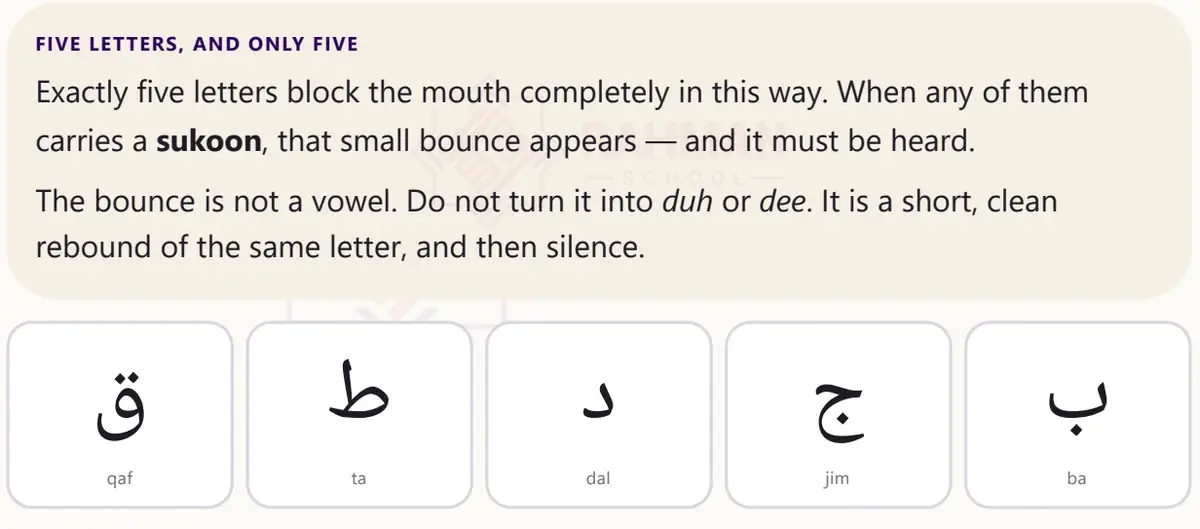
Qalqalah is the small bounce you hear when one of five letters carries a sukoon, the little circle that means “no vowel”. The five letters are ب ج د ط ق. When any of them has a sukoon, the mouth closes completely on it, and the sound comes back with a short, clean rebound. Before the bounce makes sense, though, you need sukoon itself, so this guide starts there.
This guide follows the order of the Rahman Quranic Reading Method, a new book by Rahman School that is not yet used in Rahman School’s current classes. It covers Unit 9 of the book, with the stopping rule from Unit 16. The book teaches this unit on letters and syllables only; the Quranic words below are taken from its verified Quran text, with surah and verse.
At a glance
Term
In short
Sukoon
a small circle above a letter: the letter has no vowel of its own
Sakin letter
a letter carrying a sukoon; it leans back on the letter before it
Qalqalah
a small bounce on five letters when they carry a sukoon
The five letters
ب ج د ط ق
Where it happens
inside a word, or at a stop where the reading ends
How strong
lighter inside a word; stronger and clearer at a stop
What it is not
a vowel: never “duh” or “dee”
You will see the word spelt qalqalah, qalqala or qalqalah with a capital, and sukoon spelt sukun. Rahman School’s Quran and Arabic glossary defines qalqalah in one line and gives a common memory phrase, Qutbu Jadin, whose letters are the five. The book itself does not use the phrase; it teaches the letters by sound.
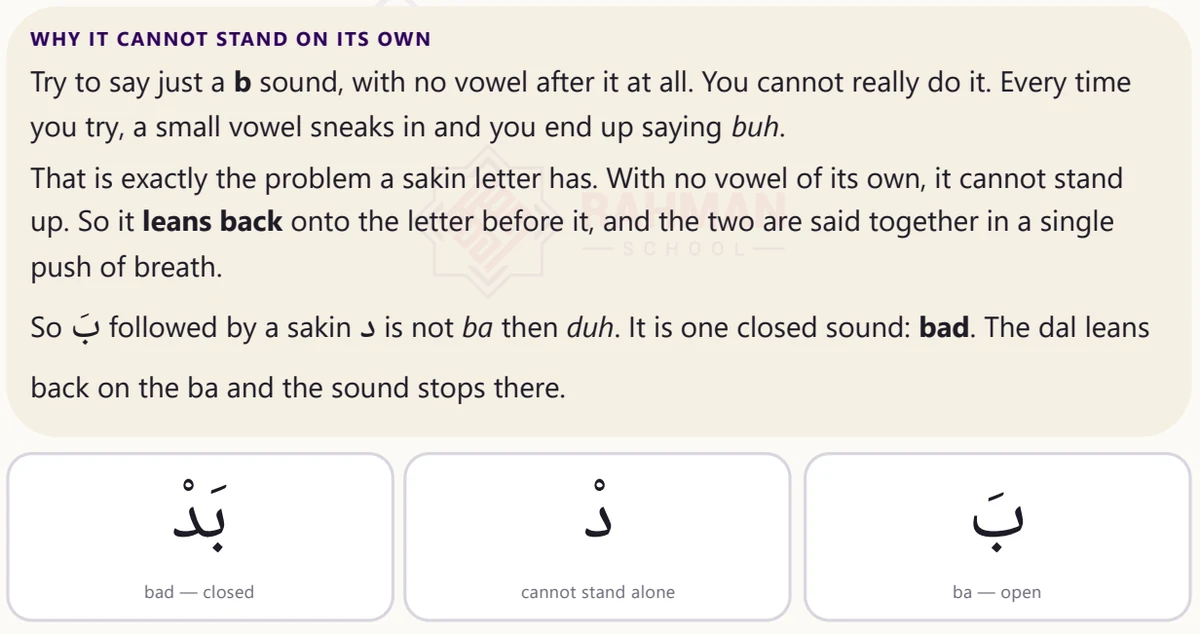
A small circle written above a letter is called sukoon. It is the opposite of a vowel mark: it tells you the letter has no vowel at all. A letter carrying it is called sakin, “still”. Here is the letter dal with a sukoon: دْ.
A sakin letter cannot stand on its own. Try to say just a “b” with no vowel after it, and a small vowel sneaks in: you end up saying “buh”. A sakin letter has the same problem, so it leans back onto the letter before it, and the two are said together in a single push of breath. So بَ followed by a sakin dal is not “ba” and then “duh”. It is one closed sound, بَدْ, said like the English word “bad”. The dal leans back on the ba, and the sound stops there.
The book then drills that closed syllable with every letter of the alphabet in the silent position, first after a fathah, then after a kasrah and a dammah. Each cell is one sound, not two: the first letter is open, the second leans back and closes it, and you stop cleanly at the end. Changing the opening vowel stops a learner from simply memorising a rhythm.
Sukoon can sit on any letter. On a noon it brings four rules of its own, explained in the guide to noon sakinah and tanween. If the three short vowels are still new, start with fathah, kasrah and dammah first, because every closed syllable begins with one of them.
Open or closed: hearing the difference
The book’s real test of this unit is a page of pairs. The letters are the same both times; only the second mark changes, from a vowel to a sukoon. A learner who reads both the same way is adding a vowel to the sakin letter without hearing themselves do it.
Open (with a vowel)
Closed (with a sukoon)
بَبَ
بَبْ
بَتَ
بَتْ
بَدَ
بَدْ
بَسَ
بَسْ
Pronunciation tip. Say the English word “bad”, then the Arabic. You already close the syllable correctly in English; the skill is simply to carry that into Arabic.
A sakin letter leans back: page 134 of the Rahman Quranic Reading Method. Tap or click the image to see it full size.
The five qalqalah letters
In the closed-syllable drills, five letters refuse to stop quietly. That is not a mistake; it is a real property of those letters. Say a sakin “s” and hold it: you can keep the sound going for as long as you have breath. Now try to say a sakin “d” and hold it. You cannot. The mouth is completely blocked, so when you release it the sound comes back with a small bounce, like a ball tapped once on a hard floor.
Exactly five letters block the mouth completely in this way. When any of them carries a sukoon, the bounce appears, and it must be heard.
Letter
Name
With a sukoon
ب
ba
بْ
ج
jim
جْ
د
dal
دْ
ط
ṭa, the heavy t; the light t, ت, does not bounce
طْ
ق
qaf
قْ
The bounce is not a vowel. Do not turn it into “duh” or “dee”. It is a short, clean rebound of the same letter, and then silence. It should also sound the same whatever vowel came before it: if it changes colour with the vowel, the learner is adding a vowel to the bounce instead of releasing the letter.
Pronunciation tip. Put a finger lightly on your throat and say a sakin dal. The bounce can be felt as well as heard, which helps a learner who cannot hear it yet.
The five qalqalah letters: page 140 of the Rahman Quranic Reading Method. Tap or click the image to see it full size.
Inside a word, or at a stop
The bounce appears wherever one of the five letters carries a sukoon. That can be inside a word, with more letters following it, or at the end, where you stop reading. It happens in both places. Many learners bounce at the end and forget in the middle, because the middle goes past quickly.
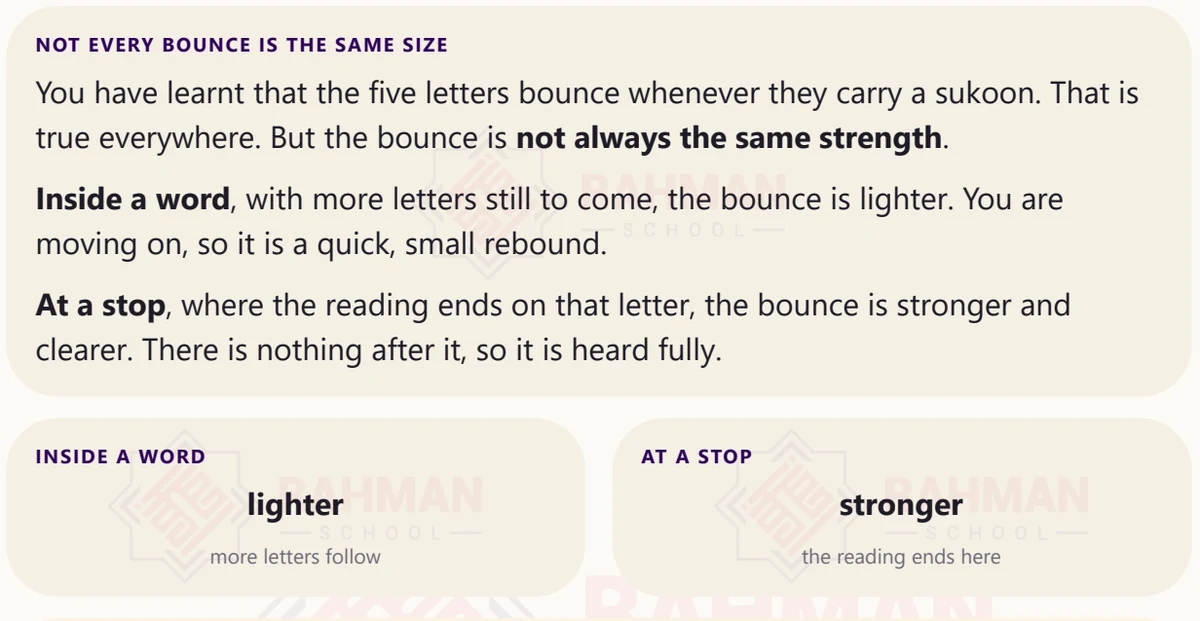
The bounce is not always the same strength. Inside a word, with more letters still to come, it is lighter: you are moving on, so it is a quick, small rebound. At a stop, where the reading ends on that letter, it is stronger and clearer, because there is nothing after it. Teachers differ on how much stronger the stopping bounce should be, and the book does not put a number on it. What matters at this stage is hearing that there is a difference at all.
Here are the five letters at work in the Quran. In the first three words the sukoon is printed inside the word. In the last three the word ends the verse; it is printed with a vowel, and the sukoon appears when you stop there, as the next section explains.
Word
Reference
Read as
Where
The bounce
ٱلْأَبْتَرُ
Quran 108:3
بْ
inside the word
lighter
ٱلْقَدْرِ
Quran 97:1
دْ
inside the word
lighter
ٱقْرَأْ
Quran 96:1
قْ
inside the word
lighter
ٱلصَّمَدُ
Quran 112:2
دْ
at a stop
stronger
ٱلْفَلَقِ
Quran 113:1
قْ
at a stop
stronger
خَلَقَ
Quran 96:1
قْ
at a stop
stronger
Two of these words also show what does not bounce. ٱقْرَأْ ends in a hamzah with a sukoon; the hamzah is not one of the five, so it stops quietly. ٱلْقَدْرِ and ٱلْأَبْتَرُ end the verse on ر, which is not one of the five either, so only the letter inside the word bounces.
One verse holds both positions. In this verse (Quran 96:1) the qaf bounces lightly inside the first word, and strongly at the end of the verse, where you stop on the last word. The hamzah that ends the first word stops quietly.
Listen to the complete verse: Surah Al-Alaq, Quran 96:1
When stopping creates a sukoon
A sukoon does not have to be printed. The book’s final unit teaches that two things change when you stop reading on a word. First, the final vowel is dropped, so the word ends on a bare letter. Second, if that final letter is one of the five, the bounce appears clearly. That is why ٱلْفَلَقِ ends with a clear bounce on the qaf when you stop at the end of the verse, even though the qaf is printed with a kasrah.
Surah Al-Ikhlas, which the book prints in full, shows the same thing. In this verse (Quran 112:2) the last word ends in a dal printed with a dammah. Stop at the end of the verse, and the dammah is dropped and the dal bounces clearly.
Listen to the complete verse: Surah Al-Ikhlas, Quran 112:3
In يَلِدْ the dal ends the word, but the reading carries straight on into the next word, so you bounce cleanly and keep going. In يُولَدْ the dal ends the verse, and stopping there gives the full, clear bounce.
The book prints this surah, Al-Ikhlas, in full near its end, and asks the learner to stop at the end of every verse. All four verses end on a dal, so each stop ends with the same clear bounce. The surah’s first verse is also the one used in the pillar guide to show this stop.
Where you may stop is guided by small signs printed above the line in the Mushaf, and the exact signs differ between printings. Rahman School’s guide to Quran stop signs with examples explains them.
Two strengths of bounce: page 144 of the Rahman Quranic Reading Method. Tap or click the image to see it full size.
Common mistakes
These are the mistakes the book’s teacher notes warn about:
Sneaking a vowel after a sakin letter.بَدْ becomes “ba-da”. This is the fault the whole unit is built to catch.
Turning the bounce into a vowel. The bounce is a short release of the letter, then silence: never “duh” or “dee”.
Bouncing letters that are not one of the five. Over-bouncing is as much an error as under-bouncing, and once the rule has been taught it is the more common one.
Bouncing at the end and forgetting in the middle. The bounce happens inside a word too; it is just lighter there.
Letting the bounce change with the vowel before it. It should sound the same after a fathah, a kasrah or a dammah.
Bouncing a letter that carries a vowel. Qalqalah needs a sukoon, printed or made by stopping. A qaf with a fathah in the middle of a verse does not bounce.
Practising: accuracy first, then pace
The book’s fluency page uses three runs over the same mixed set of closed syllables. Run 1 is for accuracy only: read every item correctly, without hurrying, and count the mistakes. Run 2 is for speed: the same items as fast as you can without a mistake, timed. Run 3 comes two days later, timed again. Accuracy is never traded for pace. Bouncing and non-bouncing letters are mixed together, because speed is what reveals a bounce in the wrong place.
If the added-vowel fault appears on more than four items of a check, the book’s advice is to go back to the open-and-closed pairs every day for a week before moving on. At the end of the unit it checks six things: no vowel after a sakin letter; the sakin letter joined to the one before; the five letters named from memory; a clean bounce, not a vowel; no false bounces; and a bounce both in the middle and at a stop. Sukoon has to be secure before the next unit, because shaddah is taught as a sakin letter followed by a vowelled one.
A parent who does not speak Arabic can still support practice at home, for example by timing the three runs or by asking which letters should bounce before each set. The sound of the bounce itself must come from a qualified teacher or an approved recitation.
Short practice exercises
These exercises use the book’s own practice cells, plus six Quranic words. Say each answer aloud, ideally to a teacher, and check the answers at the end.
Exercise 1: bounce or no bounce? Every syllable ends in a sakin letter. Which ones should bounce?
No.
Syllable
1
بَدْ
2
بَلْ
3
بَقْ
4
بَهْ
5
بَجْ
6
بَنْ
7
بَصْ
8
بَبْ
Exercise 2: open or closed? Say whether each syllable is open (ends in a vowel) or closed (ends in a sukoon), then whether it bounces.
No.
Syllable
1
بَتِ
2
بَحْ
3
بَدَ
4
بَرْ
5
بَطْ
6
بَسُ
7
بَقْ
8
بَجَ
Exercise 3: find the bounce in the Quran. Each word contains one of the five letters with a sukoon, printed or made by stopping at the end of the verse. Name the letter, and say whether the bounce is inside the word or at a stop.
No.
Word
Reference
1
بِٱلصَّبْرِ
Quran 103:3
2
ٱلْفَجْرِ
Quran 97:5
3
وَقَبَ
Quran 113:3
4
ٱلْمَبْثُوثِ
Quran 101:4
5
حَسَدَ
Quran 113:5
6
سَنَدْعُ
Quran 96:18
Exercise 4: one mark, two sounds. Read بَدْ and then بَدَ. Explain the difference in your own words.
Exercise 5: make the mistake on purpose. Add a vowel to a sakin letter so that you can hear the mistake, then read it correctly. Which sounds heavier and slower? Making an error deliberately is one of the most reliable ways to hear a fault you have been making without noticing.
Answers
Exercise 1: bounce on 1 (dal), 3 (qaf), 5 (jim) and 8 (ba). No bounce on 2 (lam), 4 (ha), 6 (noon) and 7 (sad): they stop silently.
Exercise 2: 1 open. 2 closed, no bounce. 3 open: the dal has a vowel, so it does not bounce. 4 closed, no bounce. 5 closed, bounces (ṭa). 6 open. 7 closed, bounces (qaf). 8 open: the jim has a vowel, so it does not bounce.
Exercise 3: 1 ba, inside the word. 2 jim, inside the word. 3 ba, at a stop. 4 ba, inside the word. 5 dal, at a stop. 6 dal, inside the word.
Exercise 4: the first is one closed sound, “bad”, ending in a sakin dal that bounces. The second is two open sounds, “ba-da”: the dal carries a fathah, so it does not bounce.
Exercise 5: the version with the added vowel sounds heavier and slower. The correct reading is one closed syllable.
Frequently asked questions
What are the qalqalah letters?
There are five: ب ج د ط ق (ba, jim, dal, ṭa and qaf). They bounce only when they carry a sukoon.
Does qalqalah happen on a letter with a vowel?
No. Qalqalah needs a sukoon. The sukoon can be printed on the letter, or it can come from stopping on the last letter of a word, which drops the final vowel.
Is qalqalah stronger at the end of a verse?
At a stop it is stronger and clearer than inside a word, and the end of a verse is the most common place to stop. Teachers differ on how much stronger it should be, and the book does not set a number.
What is sukoon?
A small circle written above a letter. It means the letter has no vowel of its own, so it leans back on the letter before it and closes the syllable.
How do I stop adding a vowel after a silent letter?
Say the English word “bad”, then the Arabic, and notice that you already close the syllable in English. Then practise open-and-closed pairs every day, and try making the mistake on purpose so that you can hear it.
Is the bounce the same as a vowel?
No. It is a short, clean release of the same letter, followed by silence. Turning it into “duh” or “dee” adds a vowel that is not there.
Learn with a teacher
The Rahman Quranic Reading Method is a new book and is not yet used in Rahman School’s classes. Rahman School’s current classes are live, one-to-one lessons online with a teacher, and qalqalah is taught in the online Tajweed classes. For a wider view of how Tajweed study fits together, see how to learn the Quran with Tajweed.
New students are eligible for two free 30-minute trial lessons, so you can try a lesson with a teacher before deciding.