Noon Sakinah and Tanween: The Four Rules Explained with Examples
By Rahman School
A noon with no vowel on it, called noon sakinah, and the “n” sound at the end of a tanween follow exactly the same rules. What happens to that “n” depends entirely on the very next letter, and there are only four possibilities: say it clearly (Izhar), turn it into a meem (Iqlab), merge it into the next letter (Idgham), or hide it with a hum (Ikhfa). Every letter of the alphabet belongs to one of the four, so once you know the letter groups you never have to guess.
This guide follows the order of the Rahman Quranic Reading Method, a new book by Rahman School that is not yet used in Rahman School’s current classes. It covers Unit 13 of the book, and every Quranic example below is one the book itself prints, with its surah and verse.
At a glance
Rule
If the next letter is
What you do
Letters
Izhar
ء ه ع ح غ خ
say the noon clearly
6
Iqlab
ب
turn it into a humming meem
1
Idgham
ي ر م ل و ن
merge it into the next letter
6
Ikhfa
any of the other fifteen
hide it and hum
15
These four names are the standard Tajweed terms. You will also see them spelt in other ways, such as ikhfaa (the book’s own spelling) or idghaam, and Rahman School’s Quran and Arabic glossary gives a one-line definition of each.
The unit begins by joining two things the learner already knows. A noon carrying a sukoon, نْ, is a noon with no vowel after it. A tanween is a vowel mark written twice at the end of a word, as in بً, and it adds an “n” sound that is never written as a letter. Say both aloud and the ending is the same “n”. That is why Arabic treats them as one subject, and why everything in this guide applies to both.
The doubled marks have their own names: two fathahs are called fathatain, two kasrahs kasratain, and two dammahs dammatain. If the single marks are still new, start with the guide to fathah, kasrah and dammah, and see Unit 8 of the pillar guide for how tanween itself is read.
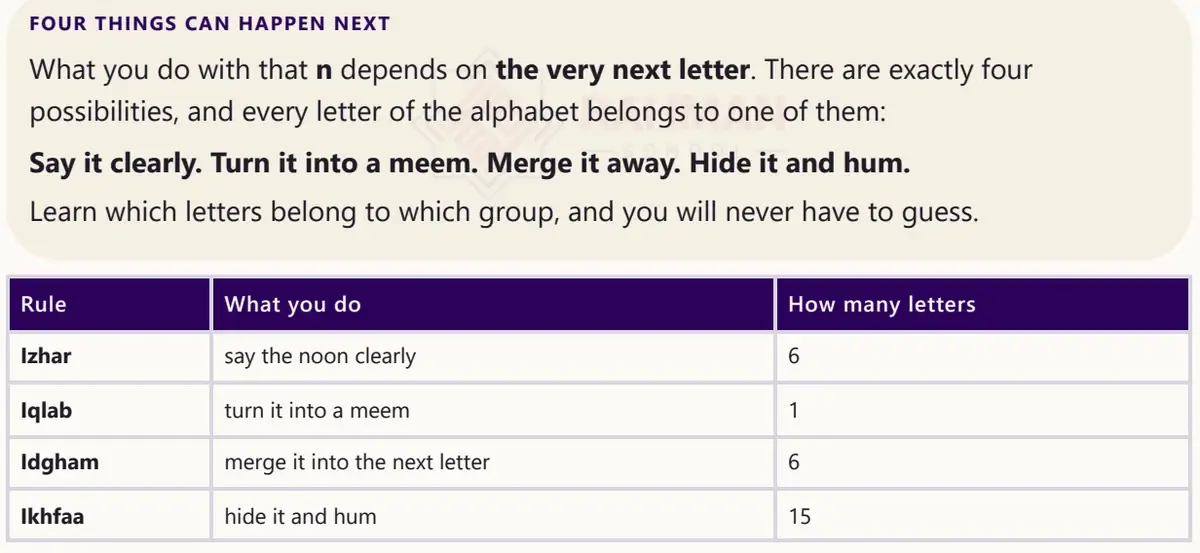
What you do with the “n” depends on the letter that comes straight after it. The book gives four short instructions for the four rules: say it clearly, turn it into a meem, merge it away, hide it and hum. It also points out a small sum worth showing any learner: six letters plus one plus six plus fifteen makes twenty-eight, the whole alphabet. The four rules cover every letter, so there is nothing left over.
The four rules and their letter counts, from page 186 of the Rahman Quranic Reading Method. Tap or click the image to see it full size.
Izhar: say it clearly
Izhar means making clear. Before six letters, you do nothing special at all: the noon is said exactly as it always is, with no humming, no merging and no change. All six are made in the throat, which is why the full name of the rule means “throat izhar”. The throat is too far back in the mouth for the noon to blend into them.
The six throat letters are: ء ه ع ح غ خ
Example
Reference
The “n” comes from
Next letter
أَنْعَمْتَ
Quran 1:7
noon sakinah, inside one word
ع
مِنْ عَلَقٍ
Quran 96:2
noon sakinah, end of a word
ع
وَجَنَّٰتٍ أَلْفَافًا
Quran 78:16
tanween
أ
تَنْهَرْ
Quran 93:10
noon sakinah, inside one word
ه
In the third example the letter after the tanween is a hamzah written sitting on an alif. It is still the hamzah, one of the six throat letters, so the rule is Izhar.
Pronunciation tip. Put a finger on your throat and say the six letters: feeling where they are made explains the rule better than a list. Then watch for over-correction. A learner who has just been told “say it clearly” sometimes starts stressing the noon. Clear does not mean loud. The noon should sound exactly as it would anywhere else.
Iqlab: turn it into a meem
Iqlab means turning over, and it applies before exactly one letter: ب. When a noon sakinah or a tanween is followed by ba, the “n” is not said at all. It turns into an “m”, held with a hum.
The reason is in the mouth. Try saying an “n” and then a “b” quickly. Your lips have to close for the “b”, and the easiest sound to make while they close is an “m”. The language simply follows the mouth.
Iqlab is also one of the few rules the Mushaf shows you directly. A small meem is often printed above the noon as the instruction to make this change. Look for the small meem in each of these examples from the book:
Example
Reference
The “n” comes from
Next letter
مِنۢ بَعْدِ
Quran 98:4
noon sakinah, end of a word
ب
ٱنۢبَعَثَ
Quran 91:12
noon sakinah, inside one word
ب
حِلٌّۢ بِهَٰذَا
Quran 90:2
tanween
ب
Here is the second example in its complete verse (Quran 91:12), with the small meem printed above the noon:
Listen to the complete verse: Surah Ash-Shams, Quran 91:12
Pronunciation tip. Close the lips for the meem and let the sound come out through the nose as a hum before the “b”. That nasal hum is called ghunnah, and the book first teaches it in Unit 10: pinch your nose while humming and the sound stops, because it was coming through the nose all along.
Idgham: merge it into the next letter
Idgham means merging. Before six letters the noon is not pronounced at all. It merges into the letter that follows, and that letter is doubled instead. This happens between two words: the noon ends one word and the merging letter begins the next.
The six letters fall into three pairs, and each pair behaves slightly differently. A tanween before these letters follows exactly the same pattern as a noon sakinah; the examples below use a noon sakinah so that the merge is easy to see.
Kind of merge
Letters
Hum?
Complete, with a hum
ن م
yes
Complete, without a hum
ل ر
no
Incomplete, with a hum
ي و
yes, a trace
“Complete” means the noon vanishes entirely into the next letter, and nothing of it is left. “Incomplete” means most of it merges but a trace of the hum remains: the noon is gone as a letter, yet you can still hear that something was there.
Complete, with a hum
The noon merges and the hum stays. The book’s instruction is to hold the hum for about two beats. Here the noon of the first word disappears into the doubled noon that begins the second:
Example
Reference
The “n” comes from
Next letter
فَلَن نَّزِيدَكُمْ
Quran 78:30
noon sakinah, end of a word
ن
The same example in its complete verse (Quran 78:30):
Listen to the complete verse: Surah An-Naba, Quran 78:30
Complete, without a hum
Only two letters take the hum away completely: ل and ر. These are the ones to watch, because once a learner has met humming the natural temptation is to hum on everything. If you remember only one thing from this section, make it this pair.
Example
Reference
The “n” comes from
Next letter
أَن رَّءَاهُ
Quran 96:7
noon sakinah, end of a word
ر
لَئِن لَّمْ
Quran 96:15
noon sakinah, end of a word
ل
يَكُن لَّهُۥ
Quran 112:4
noon sakinah, end of a word
ل
The first example in its complete verse (Quran 96:7), where the noon vanishes into the ra with no hum:
Listen to the complete verse: Surah Al-Alaq, Quran 96:7
Incomplete, with a hum
Before ي and و, most of the noon merges but a trace of the hum stays.
Example
Reference
The “n” comes from
Next letter
فَمَن يَعْمَلْ
Quran 99:7
noon sakinah, end of a word
ي
Pronunciation tip. The book suggests reading each set of examples twice: once listening only for the hum, and once listening only for whether the noon has truly disappeared. Separating the two makes both easier to hear.
Why “between two words” matters
The book stresses that “between two words” is not a detail: it is the condition. When a noon sakinah is followed by ya or waw inside the same word, there is no merging, and the noon is said clearly instead. The reference the book follows states that this happens in only four words in the whole Quran. Because there are so few, they are best learned by sight, with a teacher pointing out each one in the Mushaf.
Ikhfa: hide it and hum
Six letters take Izhar, one takes Iqlab and six take Idgham. That is thirteen, and the other fifteen all take Ikhfa. Ikhfa means hiding. The noon is neither said clearly nor merged away; it sits somewhere in between. The tongue does not quite touch, and the sound goes out through the nose as a hum while the mouth gets ready for the next letter.
The fifteen letters are: ت ث ج د ذ ز س ش ص ض ط ظ ف ق ك
The hum takes the colour of the letter that follows. Before a heavy letter it is full and round; before a light letter it is thin. You are not doing anything different: your mouth is simply already shaping the letter that is coming. Five of the fifteen are heavy letters from Unit 1 of the book, ص ض ط ظ ق, and the other ten are light.
Example
Reference
Hum
Next letter
مَن دَسَّىٰهَا
Quran 91:10
thin (light letter)
د
وَأَنتَ
Quran 90:2
thin (light letter)
ت
أَنقَضَ
Quran 94:3
full (heavy letter)
ق
عَن صَلَاتِهِمْ
Quran 107:5
full (heavy letter)
ص
Pronunciation tip. Ikhfa is the most common of the four rules, and the one learners most often turn into a plain, clear noon. The pinched-nose test from Unit 10 works here too: if the sound carries on unchanged when the nose is pinched, there is no hum, and the learner is saying a plain noon.
Name the rule before you read
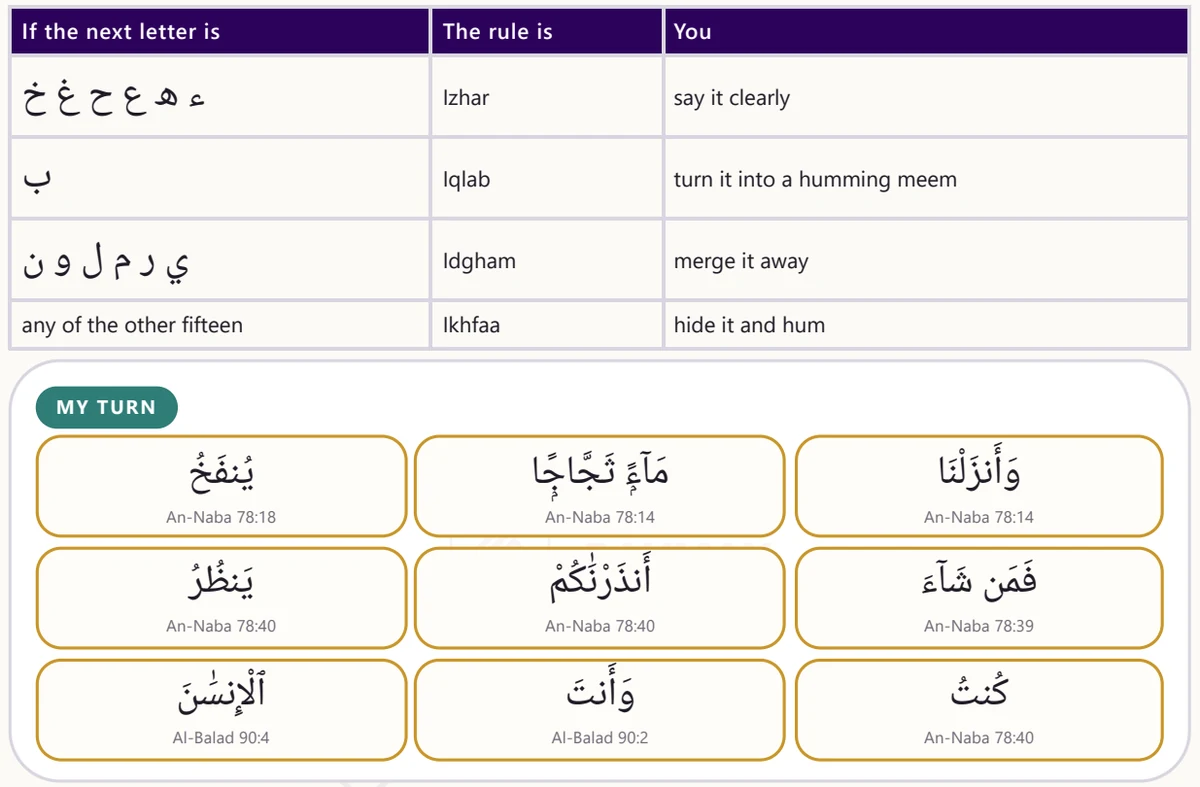
Decide, then read: the rule table and practice phrases from page 199 of the Rahman Quranic Reading Method. Tap or click the image to see it full size.
The book’s practice page for the whole unit has one instruction: look at the letter after the noon, name the rule, and only then read. The skill being built is looking forward to the next letter before reading the current one, and all four rules depend on that habit. The book recommends keeping this table in view while practising:
If the next letter is
The rule is
You
Hum?
ء ه ع ح غ خ
Izhar
say it clearly
no
ب
Iqlab
turn it into a humming meem
yes
ن م
Idgham
merge it away
yes
ل ر
Idgham
merge it away
no
ي و
Idgham
merge it, keeping a trace of the hum
yes, a trace
any of the other fifteen
Ikhfa
hide it and hum
yes
At the end of the unit, the book checks six things before a learner moves on: noon and tanween are treated alike; the Izhar letters are known and the noon stays clear; the noon becomes a humming meem before ba; in Idgham the noon disappears and the hum is right for each pair; in Ikhfa the noon is hidden with a hum, not said plainly; and the learner names the rule before reading. Only when all six are secure does the book move on to the meem rules.
Short practice exercises
These exercises use the book’s own practice items. Name the rule first, then read the item aloud, ideally to a teacher, and check the answers at the end.
Exercise 1: which rule does this letter call for? Each letter below comes straight after a noon sakinah or a tanween. Name the rule.
No.
Next letter
1
ق
2
ع
3
ب
4
ل
5
ي
6
خ
7
م
8
س
Exercise 2: name the rule, then read. Look at the noon or tanween and the letter after it, name the rule, then read the phrase.
No.
Phrase
Reference
1
مَنْ أَعْطَىٰ
Quran 92:5
2
مَنۢ بَخِلَ
Quran 92:8
3
أَن لَّمْ
Quran 90:7
4
فَمَن شَآءَ
Quran 78:39
5
لَّن يَقْدِرَ
Quran 90:5
6
فَٱنصَبْ
Quran 94:7
7
عَنْهُ
Quran 92:11
8
أَجْرٌ غَيْرُ
Quran 95:6
Exercise 3: the sum. Six plus one plus six plus fifteen: what does that add up to, and why does the number matter?
Exercise 4: find it in the Mushaf. Open a Mushaf and find a small meem printed above a noon. What is it telling you to do?
Answers
Exercise 1: 1 Ikhfa (heavy, so a full hum). 2 Izhar. 3 Iqlab. 4 Idgham without a hum. 5 Idgham, incomplete, with a trace of the hum. 6 Izhar. 7 Idgham with a hum. 8 Ikhfa (light, so a thin hum).
Exercise 2: 1 Izhar (أ). 2 Iqlab (ب). 3 Idgham without a hum (ل). 4 Ikhfa, thin hum (ش). 5 Idgham, incomplete, with a trace of the hum (ي). 6 Ikhfa, full hum (ص). 7 Izhar (ه). 8 Izhar: this one is a tanween, followed by a throat letter (غ).
Exercise 3: twenty-eight, the whole alphabet. It shows that the four rules cover every letter, so there is never a letter with no rule.
Exercise 4: it is the sign of Iqlab: turn the noon into a humming meem, because the next letter is ba.
One verse, two rules
In real reading the rules come one after another, often in the same verse. This verse contains two of them.
Listen to the complete verse: Surah Al-Alaq, Quran 96:2
In this verse (Quran 96:2), the second word, ٱلْإِنسَٰنَ, has a noon sakinah followed by س, one of the fifteen Ikhfa letters, so the noon is hidden with a thin hum. Then مِنْ ends in a noon sakinah, and the next word begins with ع, a throat letter, so the noon is said clearly: Izhar. Name both rules before you read the verse, then listen to it recited by a qualified teacher.
The same idea for meem sakinah
The next unit of the book applies the same three ideas, clear, merged and hidden, to a meem with no vowel. That system is smaller: there are three rules instead of four and nothing like Iqlab. Before ب the meem is hidden with a hum, before another م the two merge with a hum, and before every other letter the meem is said clearly. All three rule names end in shafawi, “of the lips”, because that is where a meem is made. The meem sakinah section of the pillar guide gives the overview. The book moves on to these rules only when the four noon rules are secure, because learning the two systems at once confuses both.
Common mistakes
These are the mistakes the book’s teacher notes warn about most often:
Humming on everything.ل and ر take the hum away completely. This pair is the one place in Idgham that is not forgiving.
Turning Ikhfa into a plain noon. Ikhfa is the commonest rule, and the noon must be hidden with a hum, not said clearly. Use the pinched-nose test.
Stressing the noon in Izhar. Clear does not mean loud. The noon sounds as it would anywhere else.
Ignoring “between two words”. Idgham needs two words. A learner who ignores the condition will misread the four words where the noon stays clear.
Adding a vowel after the tanween “n”. Stop on the “n”. Turning “-an” into “-ana” is the commonest fault with tanween, and it changes the word.
Reading before looking ahead. Every rule depends on the letter that comes next. Name the rule first, then read.
A parent who does not speak Arabic can still support practice at home, for example by asking the learner to name the rule before each item, or by reading a set twice, once for the hum and once for the noon. The correct sound of each rule, though, must come from a qualified teacher or an approved recitation.
Frequently asked questions
What are the four rules of noon sakinah?
Izhar (say the noon clearly), Iqlab (turn it into a meem), Idgham (merge it into the next letter) and Ikhfa (hide it and hum). Which one applies depends only on the letter that follows the noon.
Is tanween treated like noon sakinah?
Yes. A tanween ends in the same “n” sound as a noon sakinah, so it follows exactly the same four rules. The book’s end-of-unit check includes treating the two alike.
Which are the Izhar letters?
The six throat letters: ء ه ع ح غ خ. Before them the noon is said clearly, with no hum.
What is the difference between Idgham with and without a hum?
In both, the noon disappears into the next letter. Before ن or م the full hum is kept, and before ي or و a trace of it remains. Before ل or ر there is no hum at all.
Why does the noon turn into a meem before ba?
Because the lips must close for the “b”, and the easiest sound to make while they close is an “m”. The Mushaf often prints a small meem as a reminder.
Does Idgham happen inside one word?
No. Idgham happens between two words. When a noon sakinah is followed by ya or waw inside the same word, the noon is said clearly, and the book notes that this occurs in only four words of the Quran.
Learn with a teacher
The Rahman Quranic Reading Method is a new book and is not yet used in Rahman School’s classes. Rahman School’s current classes are live, one-to-one lessons online with a teacher, and the rules in this guide are taught in the online Tajweed classes. For a wider view of how Tajweed study fits together, see how to learn the Quran with Tajweed.
New students are eligible for two free 30-minute trial lessons, so you can try a lesson with a teacher before deciding.