
Quran Stop Signs (Waqf Marks) Explained with Examples
What Are Quran Stop Signs?
Quran stop signs — known in Arabic as waqf marks (علامات الوقف) — are small symbols placed above or beside words in the mushaf (printed Quran). They tell the reader when to pause, when to stop completely, when to continue without breathing, and when a pause is discouraged. These marks are not part of the originally revealed text. Early Quran reciters recited from memory with oral guidance; the written waqf system was formalized later by scholars — most notably Imam al-Sajawandi in the 5th century AH — to help readers preserve correct meaning when reciting aloud.
Looking to get started? Explore our online Quran classes with expert Egyptian tutors at Rahman School.
Understanding waqf marks matters because the Quran is a text where where you pause changes the meaning. Stopping in the wrong place can join two unrelated verses, separate a subject from its predicate, or — in rare cases — produce a reading that contradicts the intended meaning. This is why learning to read with tajweed includes learning the waqf system: correct recitation is not only about pronouncing letters correctly, but about honoring sentence structure and breath.
The Complete Waqf Marks Chart
The table below lists the principal waqf marks a reader will encounter in a standard mushaf. Each mark gives a specific instruction; treating them as interchangeable is the most common mistake beginners make.
| Symbol | Name (Arabic) | Transliteration | Rule | Short meaning |
|---|---|---|---|---|
| مـ | وقف لازم | Waqf Lāzim | Compulsory stop | You must stop. Continuing may corrupt the meaning. |
| لا | لا وقف | Lā Waqf | Do not stop | Continue reading. Stopping here is discouraged. |
| ج | وقف جائز | Waqf Jāʾiz | Permitted stop | You may stop or continue — both are acceptable. |
| ط | وقف مطلق | Waqf Muṭlaq | Absolute stop | A clear stop is preferred. |
| ز | وقف مجوّز | Waqf Mujawwaz | Stop permitted but continuing preferred | Continue is slightly better. |
| ص | وقف مرخَّص | Waqf Murakhkhaṣ | Breathing pause permitted | Only when you need a breath. |
| قف | قِف | Qif | Pause | An instruction from the scribe: “stop here.” |
| ق | قيل عليه الوقف | Qīla ʿalayhi al-waqf | Said to be a stop | Some scholars stopped here; it is acceptable. |
| ك | كذلك | Kadhālik | Same as the previous | Apply whatever rule was just used. |
| ∴ ∴ | المعانقة | Muʾānaqah | The embrace | Stop at one of the two triple-dots, never both. |
The Six Most Important Waqf Marks Explained
If you are new to the mushaf, these are the symbols you will meet first. Learn these six well and you will read ninety percent of any page correctly.
Waqf Lāzim (مـ) — the compulsory stop
This is the strongest waqf in the Quran. When a reader sees this mark, stopping is not optional — continuing past it joins two verses whose combined reading can alter the meaning. For example, in Sūrah Yā Sīn (36:52), the waqf lāzim separates a quotation from the disbelievers from the angel’s reply; reading them together reverses who is speaking.
When you see مـ, take a full breath and begin the next phrase fresh.
Lā Waqf (لا) — do not stop
The opposite instruction. When you see لا, continuing is required; stopping breaks a grammatical unit — often separating a verb from its object, or a conditional from its answer.
Note: if you run out of breath and must pause on a لا, you should return and re-read the word you paused on, then continue. This preserves the grammatical flow.
Waqf Jāʾiz (ج) — your choice
The most frequently seen mark. The scribe is telling you: either option works. New readers often over-stop at جـ; experienced reciters tend to continue unless the ayah is long. When in doubt, match the phrasing of the teacher you learned from.
Waqf Muṭlaq (ط) — stop clearly
Different from waqf lāzim. The meaning is not at risk if you continue, but a pause is recommended because a new topic, subject, or rhetorical move begins. Treat ط as the scribal equivalent of a paragraph break.
Waqf Murakhkhaṣ (ص) — breathing permitted
This is a merciful mark. It tells the reader: the ayah is long, and if you need a breath here, you may take one — but it is better to continue if you can. You will often see ص in the longer verses of Sūrah al-Baqarah and al-Mā’idah.
Muʾānaqah (∴ ∴) — the embrace
The rarest and most interesting mark. Two sets of three dots appear near each other. The rule: stop at one of the two, never both, and never neither. The most famous example is in Sūrah al-Baqarah (2:2), at the phrase “ذَلِكَ الْكِتَابُ لَا رَيْبَ ۛ فِيهِ ۛ هُدًى لِّلْمُتَّقِينَ” — you stop either at “لَا رَيْبَ” (giving the meaning “this is the book — there is no doubt — in it is guidance for the god-conscious”) or at “فِيهِ” (giving “this is the book in which there is no doubt — guidance for the god-conscious”). Both readings are valid; scholars have written entire chapters on the theological implications of each.
Common Mistakes Our Teachers See
After years of teaching recitation, the Rahman School tutors see the same handful of waqf mistakes from students at every level. If you recognize yourself in any of these, correcting them will lift your recitation more than any other single change.
- Stopping on every ج. The permitted stop is permitted, not required. Over-stopping fragments the rhythm of the Quran and can make long verses feel choppy.
- Stopping at ∴ ∴ twice. If you stopped at the first set of dots, you must continue through the second. Stopping at both is specifically forbidden by the muʾānaqah rule.
- Ignoring Waqf Lāzim (مـ). Beginners sometimes read past it to “keep momentum.” This is the one mark where momentum works against you — the meaning depends on the stop.
- Breathing mid-word. If you run out of breath inside a word, you must return to the beginning of that word before continuing. Cutting a word in half is one of the most serious recitation errors.
- Not distinguishing ق from قف. They look similar on the page but mean different things. The single letter ق is a scholarly opinion (some stopped here); قف is an instruction (the scribe tells you to stop).
Waqf Examples from Three Short Surahs
To see waqf in practice, read slowly through these three short surahs — each has at least one instructive waqf placement.
Sūrah al-Fātiḥah (1:1–7) — The ending of each verse is itself a natural stop (called waqf al-āyah), so waqf marks inside are rare. Focus instead on the stops between verses and the correct breathing pattern for a short surah.
Sūrah al-Ikhlāṣ (112:1–4) — The mushaf places a clear Waqf Muṭlaq (ط) at the end of verse one (“qul huwa Allāhu aḥad ط”). This signals the thematic break: verse one states the conclusion; verses two through four explain why.
Sūrah al-Kawthar (108:1–3) — Notice the Waqf Jāʾiz (ج) between “innā aʿṭaynāka al-kawthar” and “fa-ṣalli li-rabbika wa-nḥar”. A pause here creates a beat that mirrors the structure of the command that follows.
Reading these three surahs aloud — slowly, with attention to each mark — is a faster way to internalize the waqf system than memorizing the table alone.
How to Practice Waqf Rules
Recognizing the marks on the page is the first step; applying them naturally at recitation speed is the harder skill. A practice routine that works for most students:
- Read one page per day aloud, marking every waqf you see — circle it with a pencil, or note it mentally. Over two weeks you will begin to recognize patterns without consciously checking.
- Record yourself reading a single page, then listen back. You will hear your stops more clearly than you felt them. Compare against a recording by a qualified qāriʾ (Mishary al-Afasy, Saad al-Ghamdi, and Mahmoud Khalil al-Husary are widely used references).
- Study with a teacher at least weekly. Self-correction hits a ceiling; waqf is an oral tradition and is corrected most effectively ear-to-ear.
If you are starting from zero and want a structured path, our online tajweed classes cover the full waqf system across multiple levels, and our glossary has quick definitions for every term above.
Frequently Asked Questions
How many stop signs are there in the Quran?
The standard mushaf includes nine principal waqf marks plus the muʾānaqah (triple-dot pair), giving ten symbols in common use. Different mushaf traditions — the Indo-Pakistani, the Madani, and the Warsh — sometimes use slightly different glyphs for the same rule, but the underlying system is consistent.
What does Waqf mean in Quran?
Waqf (وقف) literally means “stopping” or “pausing.” In Quranic recitation, it refers to the rules governing where a reader should pause, breathe, or stop completely.
Is it a sin to stop at the wrong place?
Not a sin in the legal sense, but it can be a recitation error that alters meaning. Serious students treat waqf as part of tajweed — the proper method of recitation — and correct errors as a matter of respect for the text.
Can I stop anywhere if I run out of breath?
Yes, but with two conditions: (1) finish the word you are on before stopping, and (2) when you resume, return to the beginning of the word or phrase for continuity.
Do the waqf marks apply in prayer (ṣalāh)?
Yes — the same rules apply whether reciting in prayer or outside of it. Within prayer, scholars permit breathing as needed without penalty, but the preference is to plan your breath to match the waqf marks.
Ready to master Quran recitation with a certified teacher?
Our Al-Azhar graduate tutors teach the full waqf system one-on-one, at your pace, from your first lesson.
Looking to study with expert teachers? Explore master all the Tajweed rules in our online classes at Rahman School.
About Rahman School
Rahman School is a professional online Quran school to learn Quran, Arabic Language, and Islamic Studies for kids & adults through one-to-one online classes.
Latest Articles
How To Learn Quran With Tajweed
Comments Off
How To Start Memorizing Quran?
Comments Off
How To Learn Modern Standard Arabic?
Comments Off
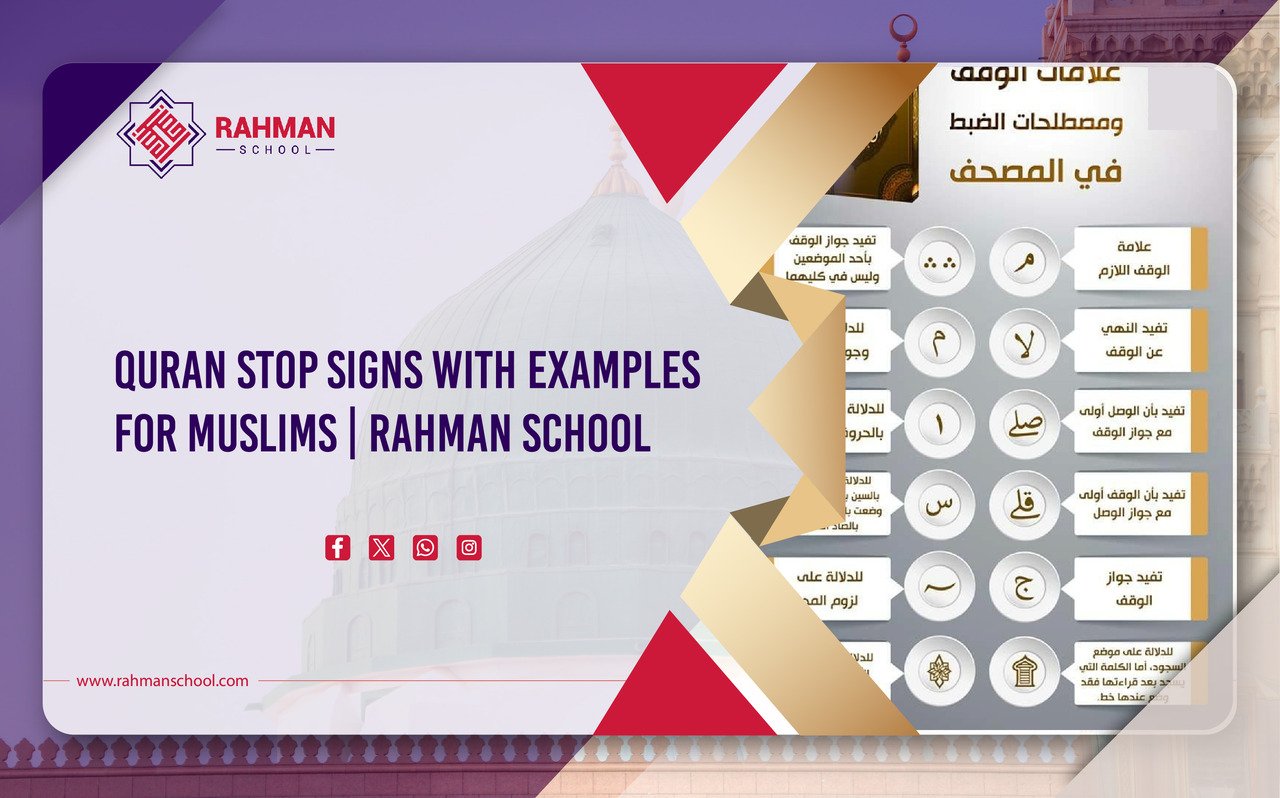
Quran stop signs with examples for Muslims
Comments Off
What is dua khatam quran?
Comments Off

how can I learn Quran?
Comments Off
Topics
Featured Courses
Quran Reading Basics
Quran Recitation with Tajweed
Quran Memorization
Get Ijazah Online
Learn Arabic Language
Learn Islamic Studies
Ready to Start Your Quran Journey?
Book 2 free trial classes with a certified Al-Azhar teacher. No payment required.
Book Your Free Trial